
Somnath Jyotirlinga, Somnath (Veraval)
- Stotram list
- No. 1
- Season
- Oct to Mar
- Railhead
- Veraval
- about 6 km
- Airport
- Diu
- about 85 km
Official website: Shree Somnath Trust (somnath.org)
The emblem here is our own drawing. The logo belongs to the trust, so we leave it on their site and keep this independent guide from being mistaken for it.
The map loads when it scrolls into view.
The story of Somnath
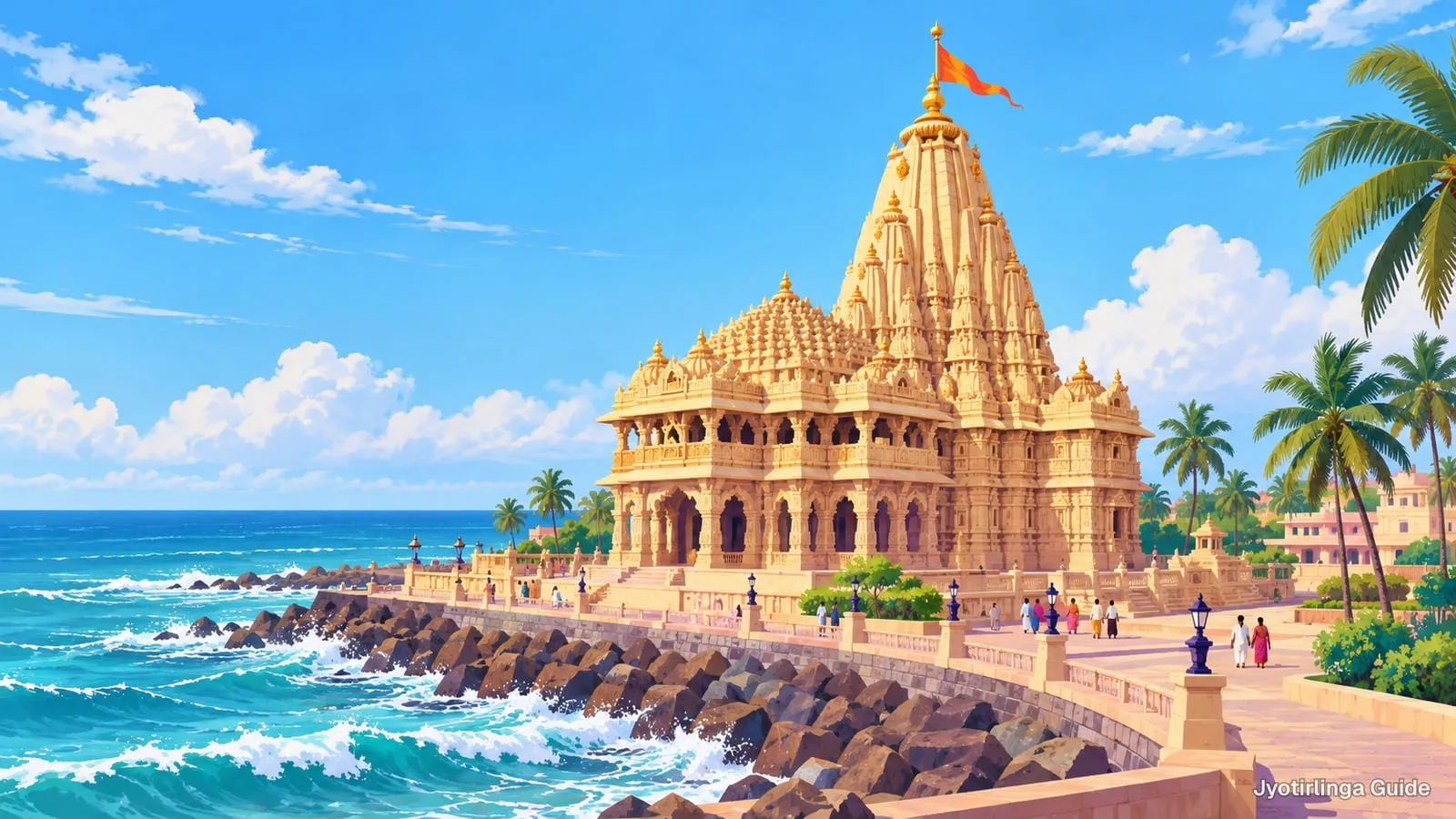
The first of the twelve, on the Arabian Sea at Prabhas Patan near Veraval in Gir Somnath district. The trust calls it the Aadi Jyotirling, on the soil where it places the last journey of Krishna.
The Moon God, Soma, is held to have been freed from the curse of his father-in-law Daksha Prajapati by the blessings of Somanath. The trust quotes the Shiva Purana and the Nandi Upapurana, in which Shiva says he is always present everywhere but especially in twelve forms and places as the jyotirlingas. The site is also mentioned in the Skanda Purana, the Shrimad Bhagavat and the Rig Veda.
The shore temple is held to have been raised in four phases, in gold by Soma, in silver by Ravi, in wood by Krishna and in stone by King Bhimadeva, and to have been desecrated six times. The trust records that the seventh temple, in the Kailas Mahameru Prasad style, was championed by Sardar Vallabhbhai Patel, with a 155 foot shikhara, a 10 ton kalash and a 27 foot dhwajdand. The Baan Stambh at the shore is read as an unobstructed sea line to the South Pole, and the trust gives the nearest land on that line as about 9,936 km away.
- Trust history page, Jay Somnath, temple trust
Darshan at Somnath
Somnath is an active temple with a daily ritual schedule, not a monument. The free queue is the default: it costs nothing and on a normal weekday it moves well. Paid darshan, if the trust offers one, buys a shorter line rather than a different view of the linga. On festival days the paid line is often suspended entirely.
Aarti is the part worth planning around. Slots are limited, some are booked days ahead, and walk-ins are turned away once the hall is full.
The temple is open for darshan from 6:00 AM to 10:00 PM, with aarti at 7:00 AM, 12:00 noon and 7:00 PM.
Source: somnath.org.
Entry is free and the trust runs no paid darshan line, so the day schedule is the whole story: open 6:00 AM to 10:00 PM, aarti at 7:00 AM, 12:00 noon and 7:00 PM, and the Jay Somnath sound and light show afterwards, which does not run in the monsoon.
The trust keeps its own festival programme and ticket-free days on its events and festivals pages, which is the page to read before a festival week.
- Trust FAQ, schedule and rules, temple trust
- Trust festivals page, temple trust
When the crowds arrive
The temple stays open through the night for well over a day: 40 hours in 2025 and 42 hours from 4:00 AM in 2026, with lakhs of visitors and heavy police arrangements.
The heaviest month of the year. News reports put Shravan 2026 at about 22.6 lakh visitors, against a normal day of more than 25,000. The Mondays and the Janmashtami holidays are the peaks.
The trust holds a five-day Lokmela, a fair, near the temple around Kartik Purnima. Rain moved it in 2025 and cut it short in 2023, so check the dates in the year you go.
- ETV Bharat Gujarati, Mahashivratri 2026, news report
- Sandesh, 42 hours open on Mahashivratri, news report
- DeshGujarat, Mahashivratri 2025, news report
- Gujarat Samachar, Shravan 2026 count, news report
- Gujarat First, Shravan 2026 count, news report
- DeshGujarat, daily visitors, news report
- ETV Bharat Gujarati, Kartik Purnima fair 2025, news report
- Abtak Media, fair moved, news report
Where to stay
Three ways people stay at Somnath, cheapest and closest first.
What is around Somnath
Evening sound and light show at the shore. Most visitors give the temple a few hours and leave the same day, which is a miss: the places worth half a day sit within a short drive, and going early or late avoids the crowd that arrives with the coaches.
- Bhalka Tirth, 5 km
- Dehotsarg Tirth, 1.5 km
- Shri Ram Mandir
- Geeta Mandir
Rules and practicalities
Mobiles, cameras, smartwatches, laptops, tablets and calculators are not allowed inside. All of it goes in the cloak room lockers, which are free.
Sarees, dhotis, trousers, t-shirts and skirts are allowed. Avoid mini skirts and what the trust calls disrespectful dress. Smoking is not allowed anywhere in the temple area.
Wheelchairs and a golf cart are available at the main gate, and there is a lift inside the temple.
Somnath on Mahashivratri and during Shravan runs on a different schedule with far longer queues. See the festival pages for what changes.
- The Jay Somnath sound and light show runs from 8:00 PM to 9:00 PM, and not in the monsoon.
- A Tirth Darshan bus leaves the main gate at 8:30 AM and 3:30 PM for the temples around Somnath, at a charge the trust does not publish.
- The trust runs a free bhojanalay.
- Lilavati and Maheshwari Samaj Atithi Gruh: Rs 750 non-AC and Rs 950 AC for two. Hari-Har Dham family rooms: Rs 2,000 and Rs 2,500. Dormitory beds: Rs 90 non-AC and Rs 200 AC. GST is extra. Sagar Darshan is the sea-facing guest house next to the temple; its page prints two different tariffs, so check the price when you book. Book on somnath.org or at the trust office only. Where to stay.
- Trust FAQ, schedule, lockers and bus, temple trust
- Free Press Journal, trust warns of fake VIP darshan, news report
- ETV Bharat Gujarati, fake VIP darshan warning, news report
- Tripadvisor forum, Veraval to Somnath autos, visitor reports
- Goibibo Q&A, Veraval to Somnath autos, visitor reports
- DeshGujarat, Jetpur to Somnath four-lane, news report
- Gulf News (IANS), Jetpur to Somnath four-lane, news report
Sources for this temple: enquiry.indianrail.gov.in, somnath.org, wr.indianrailways.gov.in, somnath.org, somnath.org. What each one covers, and the date it was read, is on the darshan and booking page.
Common questions about Somnath
What are the Somnath temple timings?
How do I reach Somnath?
Where should I stay near Somnath?
When is the best time to visit Somnath?
Also in the West group
The other temples in the West group, the gujarat coast and the maharashtra hills.


