
Trimbakeshwar Jyotirlinga, Nashik
- Stotram list
- No. 8
- Season
- Oct to Mar
- Railhead
- Nashik Road
- about 38 km
- Airport
- Nashik (Ozar)
- about 50 km
Official website: Shri Trimbakeshwar Devasthan Trust (trimbakeshwartrust.com)
The emblem here is our own drawing. The trust’s terms claim copyright and trademark over its graphics and designs.
The map loads when it scrolls into view.
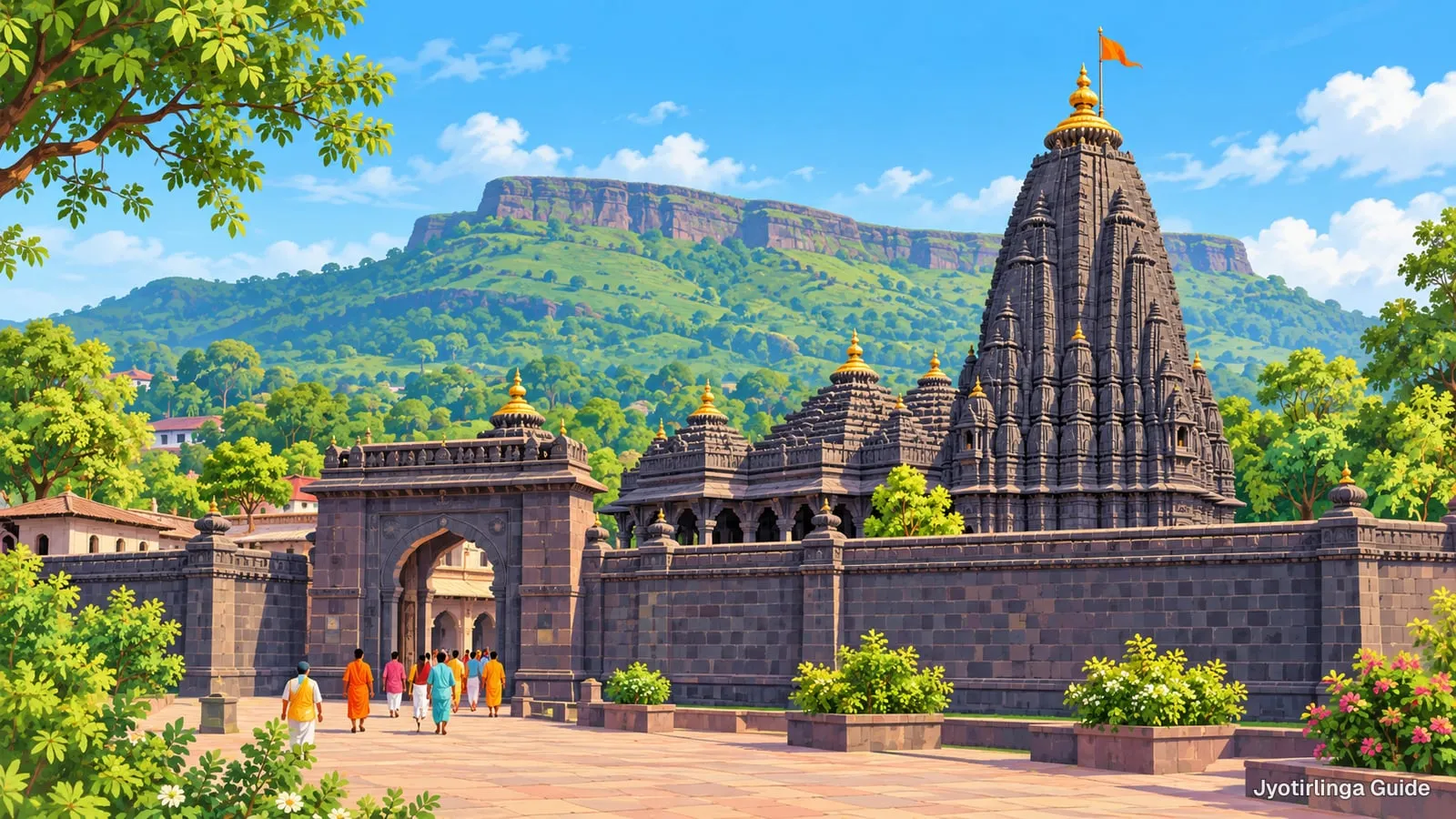
The story of Trimbakeshwar
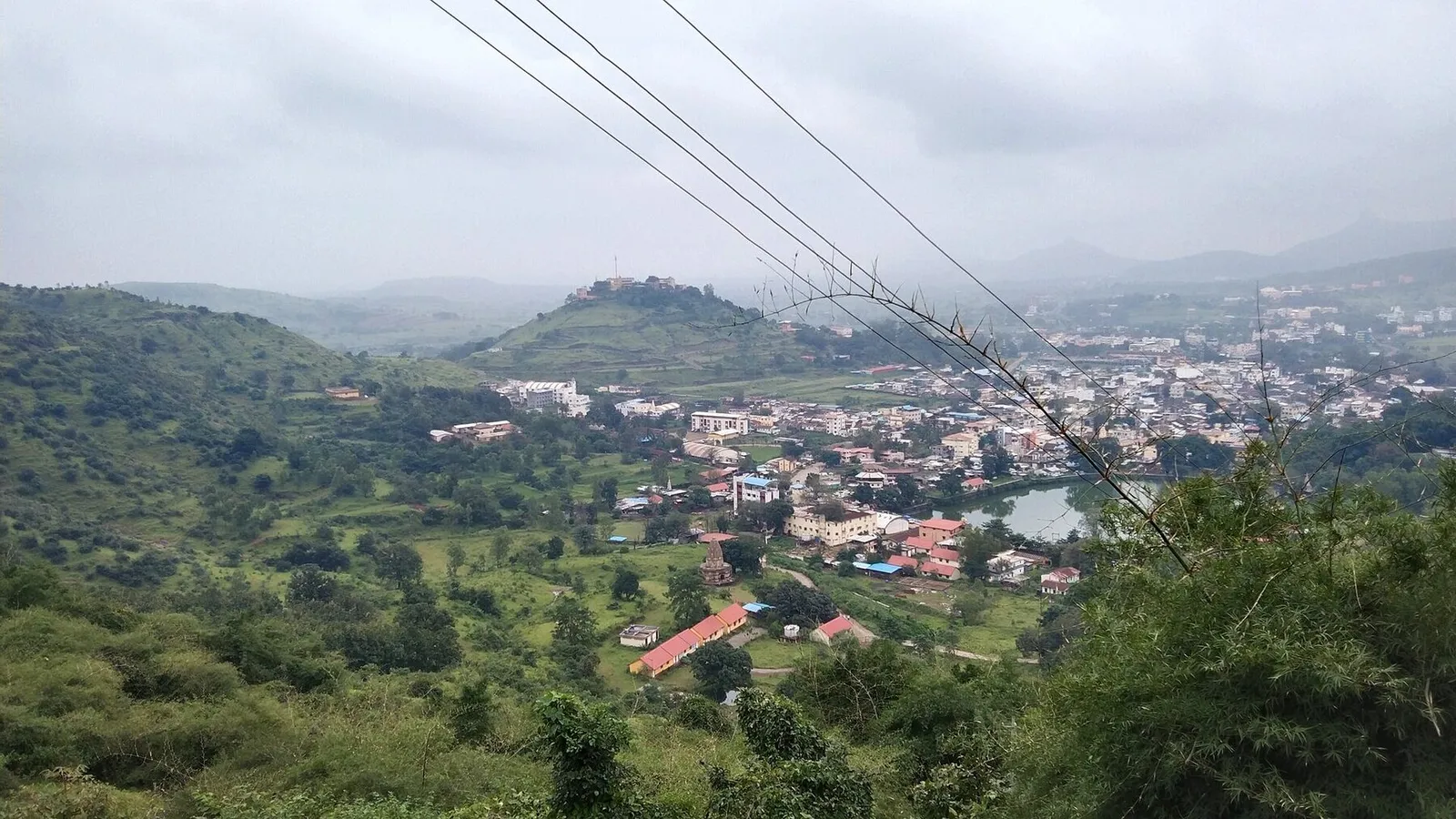
At Trimbakeshwar in Nashik district, in the Sahyadri, at the source of the Godavari.
The trust records that the present temple was built by the third Peshwa, Balaji Bajirao, between 1740 and 1760, on the site of an older temple, and opened on 16 February 1756 on Mahashivratri. It also records 400 steps on the northern side, built from a donation by Lalchand Sheth of Karachi, for the climb to the fort above.
- Trust history page, temple trust
Darshan at Trimbakeshwar
Trimbakeshwar is an active temple with a daily ritual schedule, not a monument. The free queue is the default: it costs nothing and on a normal weekday it moves well. Paid darshan, if the trust offers one, buys a shorter line rather than a different view of the linga. On festival days the paid line is often suspended entirely.
Aarti is the part worth planning around. Slots are limited, some are booked days ahead, and walk-ins are turned away once the hall is full.
Darshan runs from 5:30 AM to 9:00 PM, with three pujas through the day at the linga.
Source: trimbakeshwartrust.com.
Visitor reports describe a free general queue and a faster line for holders of the Rs 200 donation pass, sold on the trust site and at its counters and checked at the north gate. The pujas the trust sells (Rudrabhishek and Laghurudra) are booked the same way, and the rites that draw people here are done at fixed hours and need booking ahead.
Mondays, weekends, Mahashivratri and above all the Shravan Mondays are the crowded days; on those the paid pass has been stopped and the wait runs to hours. The trust lists its festival programme on its festivals page and notes that timings change on festival days.
- Trust donation darshan pass, temple trust
- Trust festivals page, temple trust
- EcoKats, free and paid queues, visitor reports
- Lokshahi, third Shravan Monday, news report
When the crowds arrive
The heaviest stretch of the year. On Shravan Mondays private vehicles are stopped outside the town, cars park at Khambale and state transport shuttles run in; the paid pass has been closed and news reports put the wait at about 3 hours. On the third Monday crowds of a lakh or more come for the Brahmagiri pradakshina, walked through the night.
News reports describe hours in the sun outside the north gate queue pavilion on weekends, and the trust has stopped the paid pass on Mahashivratri. Visitor guides agree an early weekday morning is the quietest time.
- Free Press Journal, Khambale parking and shuttle buses, news report
- Lokshahi, third Monday wait and VIP closure, news report
- Free Press Journal, pradakshina crowd and vehicle ban, news report
- Navbharat Live, weekend crowd at the north gate, news report
- Navbharat Live, Mahashivratri, news report
- EcoKats, Sunday waits and early mornings, visitor reports
Where to stay
Three ways people stay at Trimbakeshwar, cheapest and closest first.
What is around Trimbakeshwar
Kalsarp and Narayan Nagbali rites are booked in the town. Most visitors give the temple a few hours and leave the same day, which is a miss: the places worth half a day sit within a short drive, and going early or late avoids the crowd that arrives with the coaches.
- Kushavarta Kund
- Gangadwar
- Anjaneri Hill
- Brahmagiri Hill

Rules and practicalities
Visitor reports disagree on whether phones may be carried switched off or must be deposited at a counter, but agree they are not allowed near the sanctum and staff enforce it. Food and water bottles are not taken inside.
The trust publishes no dress code for darshan; wear modest clothes. Visitor reports say only men doing rites with a priest go into the sanctum itself, in a dhoti or sovale.
The trust waives the donation pass for Divyangjan (with UDID proof), anyone over 65 and women more than 6 months pregnant at the counter. No trust page mentions wheelchairs, so ask at the north gate.
Trimbakeshwar on Mahashivratri and during Shravan runs on a different schedule with far longer queues. See the festival pages for what changes.
- The pass is Rs 200 a person, valid only on the booked date, with last entry at 9:00 PM. Carry photo ID and the QR pass; children under 10 are exempt. An online booking can be cancelled only within 30 minutes.
- News reports say the trust has stopped the paid pass on Mahashivratri, and that it was closed during Shravan in 2026. Plan on the general queue for those days.
- Shivprasad Bhaktaniwas, by the Trimbakeshwar bus stand on Mahadevi Road: AC rooms for 2 at Rs 1,714, for 7 at Rs 3,333 and for 9 at Rs 4,286, non-AC for 2 at Rs 1,333, plus 5% GST. Families only, no single bookings. Bookings are non-refundable and cannot be cancelled; spare rooms go first come, first served at the desk. Where to stay.
- Google Maps, Nashik Road to the temple, map route
- Google Maps, Nashik airport (Ozar) to the temple, map route
- Trust pass counters and the north gate, temple trust
- Trust Bhaktaniwas, temple trust
- Trust daily programme, temple trust
- Maharashtra Tourism, buses, taxis and Kushavarta, state tourism
- Free Press Journal, Shravan shuttles, news report
- Navbharat Live, north gate pavilion, news report
- EcoKats, shoes, phones and the sanctum, visitor reports
- StayVista, phones, dress and buses from Nashik, visitor reports
Sources for this temple: nashik.gov.in, google.com, maharashtratourism.gov.in, google.com, enquiry.indianrail.gov.in, trimbakeshwartrust.com, trimbakeshwartrust.com, trimbakeshwartrust.com, trimbakeshwartrust.com. What each one covers, and the date it was read, is on the darshan and booking page.
Common questions about Trimbakeshwar
What are the Trimbakeshwar temple timings?
How do I reach Trimbakeshwar?
Where should I stay near Trimbakeshwar?
When is the best time to visit Trimbakeshwar?
Also in the West group
The other temples in the West group, the gujarat coast and the maharashtra hills.


